
Can Poor Quality Sleep Contribute to Weight Gain? You Bet it Can!

So we can all agree that good quality sleep is important right? Well sure it is!  Good quality sleep improves our energy levels. While we sleep it is the key time for our bodies to detoxify and to repair. Sleep helps us to keep our circadian rhythms moving along just tickety-boo. And darn it, a good night’s sleep can just make us happier.

But did you know that another bonus of a good night’s sleep is that it helps us to eat better. Yep a good night’s sleep helps us to make better food choices while we are awake.  This is because sleeping well, on a regular basis, helps to keep the hormones ghrelin and leptin in balance.  Ghrelin is a hormone that increases our appetite and leptin is a hormone that tells our brain that we have had enough to eat.

Studies have shown that even partial sleep deprivation can decrease plasma levels of leptin and increase plasma levels of ghrelin.  And increased levels of ghrelin due to poor quality sleep can lead to increased portion sizes of food and the increased hunger can cause us to make poor food choices.  I am sure that I don’t need to connect the dots for you.  Poor food choices and larger quantities of them can lead to unwanted weight gain and the cascade of health issues that can result from excess weight.

So what does “partial” sleep deprivation mean?  Well as little as 2 consecutive nights of 4 hours of sleep can do it!  It doesn’t take much does it?

The question then becomes, how do we cultivate good quality sleep?  Well it comes down to habits and routines and a few tips along the way.

Sleep in the dark

Sleeping in the dark helps with the production of the hormone melatonin.  Melatonin is important for regulating our circadian rhythm, our internal clock that helps to regulate our sleep.

Sleep in a cool room

As you drift in to La La Land your body begins to cool down.  Sleeping in a cool environment helps facilitate sleep during this stage.

Go to bed at the same time each night

When you have a consistent bedtime it actually signals to your body that rest is coming.  Back to that internal clock theme.

Shut off electronics

Your brain needs time to wind down before sleep.  Shut your television and electronics off at least a half hour before bedtime to let your brain cool down and get in to a restful state.

Don’t eat close to bedtime

If your body is working hard to digest food it is not in a restful state.  Have your last bite of food at least 2 hours before bedtime ideally though around the 3 hour mark.

The benefits of good quality sleep cannot be overstated and cultivating good bedtime habits is a big piece of your health puzzle.


References:

Metabolic and endocrine effects of sleep deprivation

A single night of sleep deprivation increases ghrelin levels and feelings of hunger in normal‐weight healthy men

Association of Sleep Adequacy With More Healthful Food Choices and Positive Workplace Experiences Among Motor Freight Workers

This Week on TheHealthHub…Circadian Rhythms and Time-Restricted Eating with Dr. Satchin Panda

Circadian Rhythms and Time-Restricted Eating


Dr. Panda is a Professor at the Salk Institute, where his research focuses on circadian rhythm in health and disease. His discoveries are among the top ten breakthroughs of the year by the Science magazine, and he is considered as one of the top 50 influential scientists in the book “Brain Trust”. Research in his lab has shown the profound impact of ambient light and daily eating-fasting rhythm on the prevention and management of chronic diseases and cancer. Currently, his lab has developed a freely available research app to study how our daily timing eating, sleeping and physical activity affect our health. Anyone can sign up for the study at mycircadianclock.org.

Learning Points:

  • What are circadian rhythms?
  • What happens when we are not in sync with our circadian clock?
  • What is time restricted eating and how does it support our circadian rhythm?


 Listen live or catch the podcast on iTunes and SoundCloud!


Every Tuesday from 11am -12pm I host The Health Hub, an interactive, forward thinking talk show on Radio Maria Canada.   Call, tweet or email your questions as together we explore health issues that are relevant to you from new and innovative points of view.

TheHealthHub is on iTunes and SoundCloud!

Subscribe and don’t miss a single episode!


Follow us on Social Media


How To Listen Live

Visit our website and learn how to listen live to our show each week.
http://www.radiomaria.ca/how-to-listen


Let us know!

If you have a health topic that you would like us to discuss or are a health care specialist who wants to be a guest on our show let us know!

Here is our email.  We would love to hear from you!
thh@radiomaria.ca


ebook

Preparing for Cancer Treatments and Dealing with Side effects

It is a reality for most cancer patients that part of your protocol will involve surgery, chemotherapy or radiation either as stand alone treatments or in combination.  With that said, it is of great importance that patients and their caregivers understand the necessity of preparing for cancer treatments and have strategies for dealing with their side effects.

Preparing your mind and body for treatment coupled with certain lifestyle adjustments can enhance therapy efficacy and reduce both the incidences and severity of side effects.  For instance, as noted in this report, Nutritional intervention and Quality of Life in Adult Oncology Patients by Marin Caro et al Marín Caro MM1, Laviano A, Pichard C 20071:

“Nutritional intervention accompanying curative treatment has an additional and specific role, which is to increase the tolerance and response to the oncology treatment (and) decrease the rate of complications”.

When side effects do occur it is of great benefit to have options in front of you to deal with them.  If too these side effects can be dealt with by natural means, medical intervention may be avoided.

In my own cancer protocol my medical treatment involved surgery, chemotherapy and radiation.  As I made my way through each I took both mental and physical notes of what I felt helped me and of those moments when I thought “boy I wish I had known that”.  And it is from this exercise coupled with my professional training that I have created my ebook.

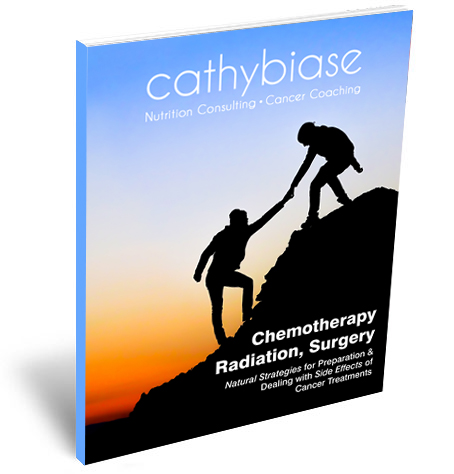
Side Effects Ebook subscriptionChemotherapy, Radiation, Surgery Natural Strategies for Preparation & Dealing with Side Effects of Cancer Treatments is a reference manual for patients and their caregivers to use before and during treatment.  It begins with strategies and tips for preparing for treatments and then moves in to chemotherapy, radiation and surgery succinctly dealing with common side effects by offering pointed complimentary strategies for dealing with each them.

I truly hope that you will find the information that is contained within my book of great benefit to you as you move through your treatments and into recovery.  Click on the button below to download this great resource for free!

Click Here to Download

Save